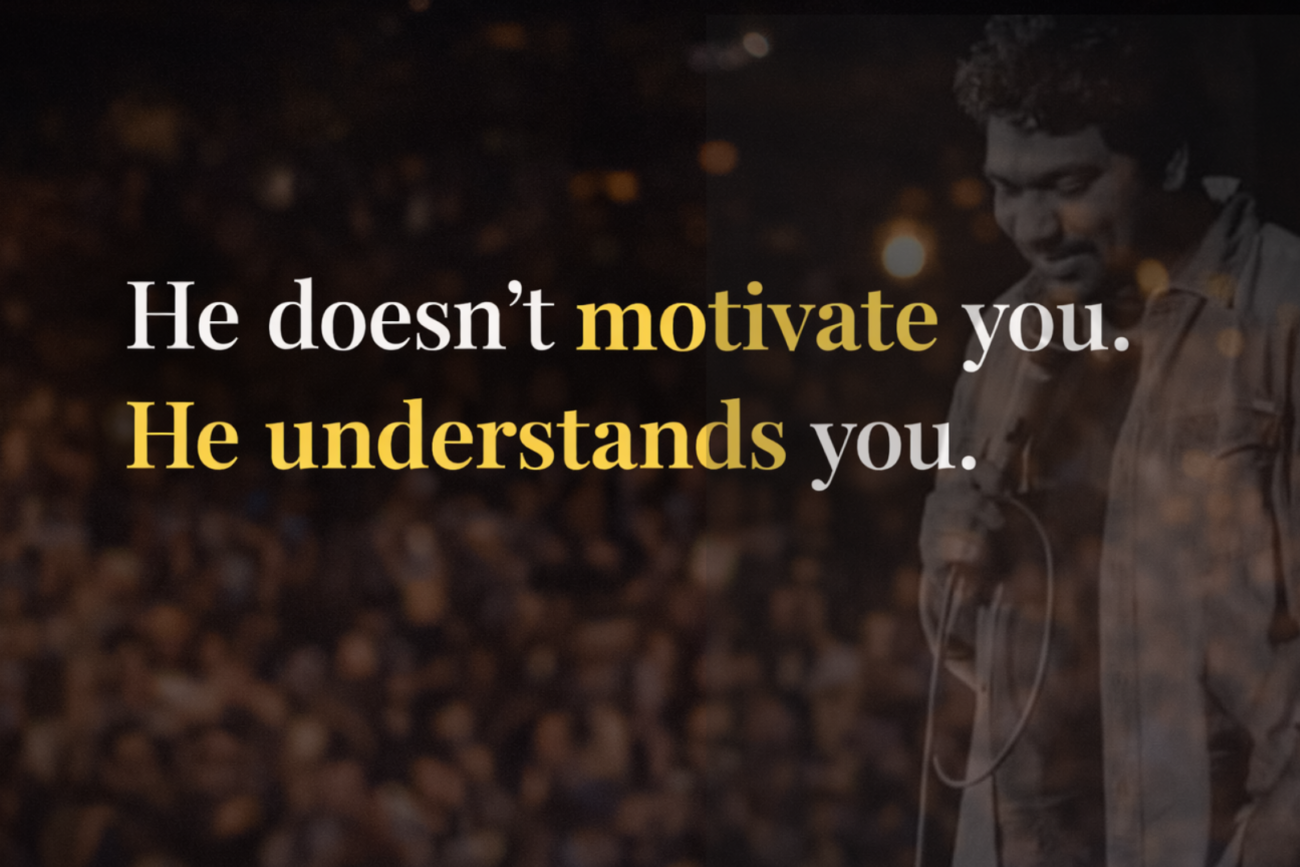
Zakir Khan has never asked you to wake up at 5am.
He has never shown you a transformation arc. Never tell you to hustle harder, dream bigger, or become a different version of yourself. And yet — millions of people quote him like he changed their life.
That contradiction is worth examining.
Because in a content landscape flooded with motivation, discipline, and aspirational storytelling, Zakir Khan does something quietly radical. He doesn’t inspire you. He understands you. And it turns out, for a large part of the Indian audience, being understood feels more powerful than being inspired.
This is the psychology of relatable storytelling — and Zakir Khan might be its most instinctive practitioner in India today.
When people try to explain why Zakir Khan is so popular, they reach for the word relatable. It’s accurate. But it’s also incomplete.
Relatable means you recognise something. What Zakir Khan does goes further — he articulates something you’ve carried for years but never found the words for.
There’s a difference between recognition and articulation. Recognition is: “I’ve felt that.” Articulation is: “I’ve felt that — and I didn’t know how to say it until just now.”
When he describes the quiet dignity of a middle-class father, or the specific embarrassment of liking someone who never noticed you, or the strange pride of calling yourself Sakht Launda when you’re actually just protecting yourself from rejection — he isn’t holding up a mirror. He’s handing you a language.
And that’s a far more intimate act.
Psychologists call this emotional resonance — the moment when an external story aligns so precisely with an internal feeling that the boundary between the two temporarily disappears. You’re not watching Zakir Khan anymore. You’re watching yourself, in his voice.
To understand why this works, it helps to separate two fundamentally different forms of storytelling.
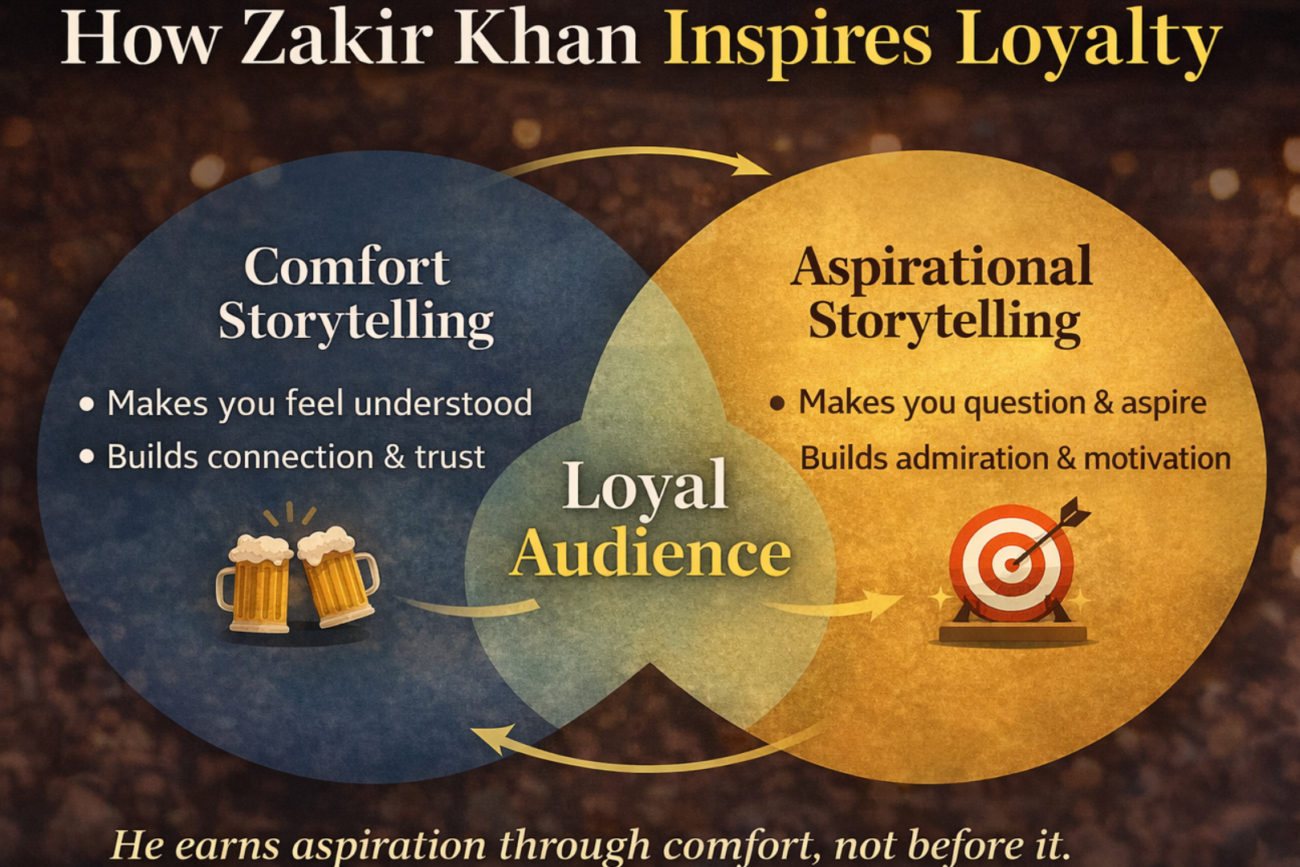
Aspirational storytelling shows you who you could become. A founder building something from nothing. An athlete pushing past their limit. A person transforming their circumstances through discipline and will. You don’t see yourself in these stories immediately — you look up at them. They create direction, movement, a sense of possibility. They work by making you slightly uncomfortable with who you currently are.
Comfort storytelling does the opposite. It doesn’t show you a destination. It meets you where you already are.
A boy who couldn’t say what he felt, so he called himself emotionally unavailable and made it a personality. A person who rehearsed conversations in their head for hours before making a phone call. Someone who stayed up too late thinking about a friendship they couldn’t explain. Comfort storytelling says: you’re not broken. This is just what being human feels like.
The psychological mechanism underneath this is validation — one of the most underrated human needs. We talk about inspiration constantly. We rarely talk about how much people need to feel that their current self, with all its ordinariness and hesitation, is acceptable.
Zakir Khan’s content — particularly Haq Se Single, Kaksha Gyaarvi, and Tathastu — operates almost entirely in this register. He isn’t building toward a lesson. He’s building toward a feeling. And that feeling, more often than not, is: it’s okay to be this.
Here’s what makes this more than just good storytelling.
When someone feels genuinely understood — not flattered, not motivated, but understood — something neurological happens. Mirror neurons, the cells in the brain that activate both when we perform an action and when we watch someone else perform it, fire in response to emotionally authentic moments. We don’t just hear the story. We briefly live it.
This is why people don’t just watch Zakir Khan — they remember exactly where they were the first time they watched Haq Se Single. They remember who they were with. The story becomes attached to their own memory, their own life.
Over time, this creates what psychologists call a parasocial connection — a genuine sense of relationship with someone you’ve never met. Not because Zakir Khan is distant and impressive, but because he feels close and familiar. Like a friend who happens to say exactly the right thing, without trying.
And this is the crucial distinction between comfort content and aspirational content when it comes to building an audience.
Aspirational storytelling creates admiration. People follow motivational creators because they want to become something. But admiration is conditional — it lasts as long as the creator stays impressive.
Comfort storytelling creates belonging. People follow Zakir Khan because being around his stories feels like being around someone who gets them. And belonging, unlike admiration, doesn’t expire.
That’s not just an emotional insight. It’s a business one.
What makes his storytelling especially sophisticated is that he doesn’t stay in one register.
On stage, in his specials, he is entirely in comfort mode. He’s remembering alongside you. The stories are about the past — the girl, the school, the father, the nights that felt endless. No lessons are extracted. No conclusions are forced. He simply tells you what happened, and trusts you to feel what it means.
But in interviews and podcasts, the tone shifts entirely. He talks about discipline, about the years nobody was watching, about what it cost him to keep going before the audience arrived. And in those moments, something different activates. You don’t just understand him — you start questioning yourself.
If he did it, from where he came from, with what he had — why can’t I?
That’s aspirational storytelling. And the reason it lands so hard in those contexts is because he earned the right to it. You already trust him. You already feel close to him. So when he shifts into the register of possibility, you move with him.
This is the real architecture of his storytelling. He doesn’t push you toward a better version of yourself before making your current version feel understood. He earns aspiration through comfort. Most creators try to do it the other way around — and wonder why their audience never quite feels invested.
The psychology of relatable storytelling isn’t complicated at its root.
People don’t always struggle because they lack direction. Often, they struggle because they feel alone in whatever they’re feeling. And when that’s the case, inspiration isn’t what they need. They need to hear their own experience spoken back to them — clearly, honestly, without judgment.
That’s what relatable content does at its best. It doesn’t teach. It doesn’t prescribe. It simply reflects. And in that reflection, something quietly shifts. The feeling that you are somehow unusual in your struggles — that everyone else has figured something out that you haven’t — loosens its grip.
“It’s not just me.”
Three words. But for the person who needed to hear them, those three words can do more than a hundred motivational quotes.
Zakir Khan has built an entire body of work on this understanding. Not consciously, perhaps — but instinctively. He knows that before a story can move you, it has to find you. And finding someone means meeting them where they actually are, not where you think they should be.
The stories that stay with us longest are rarely the ones that showed us who to become.
They’re the ones that looked at who we already were — and decided that was enough to work with.
Zakir Khan doesn’t give you a destination. He gives you company for wherever you already are. And in a world that is constantly, exhaustingly asking you to be more — that kind of company is rarer than it should be.
Maybe that’s why his lines stay. Not because they changed something in you. But because they named something that was already there, waiting to be said.
If this felt like something you’ve been thinking but never read — there’s more where this came from. Brand Untold explores the psychology behind the stories that connect.